You don’t need a beautiful notebook to start a herb journal. You need one plant, one pencil, and ten quiet minutes.

And don’t worry, I’m not much of an illustrator myself. What I’ve always done, ever since I was little, is press leaves and flowers between pages. Open my wallet and you’ll find dried flower buds tucked inside. The one I cherish most is a rosebud from my grandma. It still lives in the photo compartment.
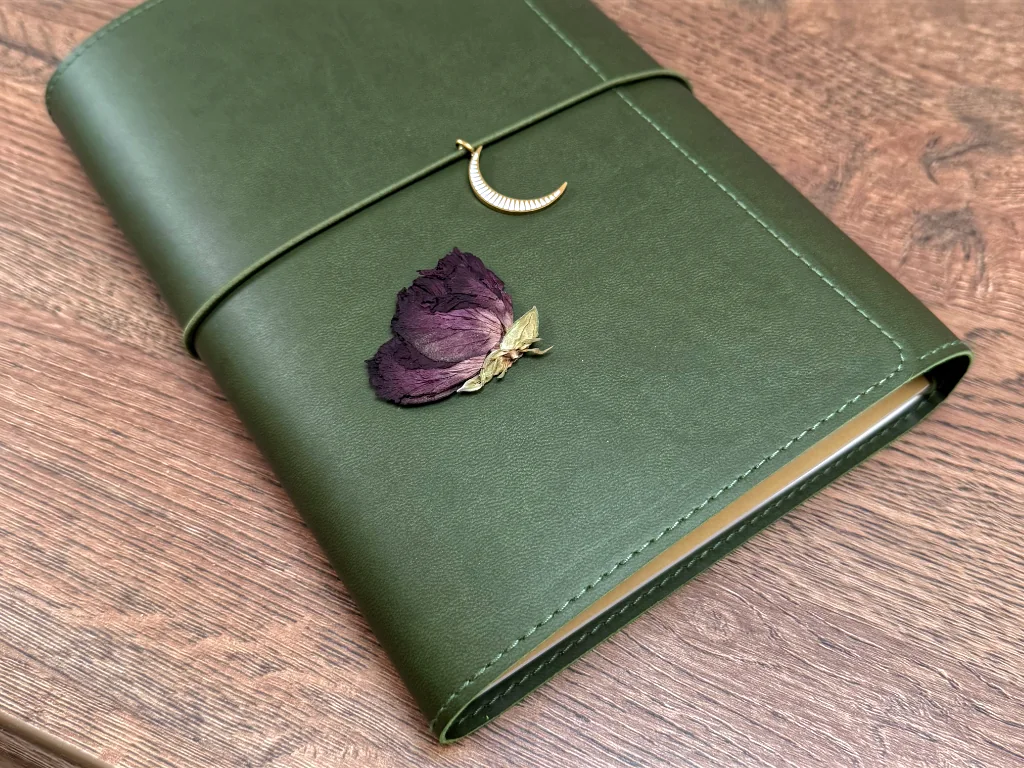
So if you’re not sure about your drawing, let that go. A herb journal isn’t a school project. It’s a place to slow down and really look. The naturalist John Muir Laws, who has taught nature journaling for decades, keeps a journal for three reasons: to see, to remember, and to wonder. None of those needs drawing. A pressed leaf you’ll recognise the plant by works just as well as any sketch.
What you need to start a herb journal
- Any notebook. Plain or dotted pages are kind to sketches and pressed leaves.
- A pencil, and a pen if you like.
- Some newspaper and a heavy book, for pressing.
- PVA glue, for sticking pressed leaves in later.
Start with three little prompts
When you sit with a plant, try three sentence starters. Laws borrowed them from an American teaching project called The Private Eye, and they work beautifully for herbs.
- I notice… The shape of the leaf. Is the edge smooth or toothed? Does it smell when you rub it?
- I wonder… Why is the stem square? Why do bees love this one and not that one?
- It reminds me of… A smell from childhood, a place, a person.
That last one is where the connection grows. You start to remember plants the way you remember people.
Write down the four things that matter
Botanists at the Natural History Museum in London say the most useful notes on any plant are where and when you found it. Add who found it (you!) and its name, if you know it. Everything else is a bonus.
So on each page, jot:
- The date
- Where you were (garden, balcony, a lane near home)
- The weather, if it changed how the plant looked
- The plant’s name, or “don’t know yet”
“Don’t know yet” is a perfectly good entry. The name can come later; the noticing is the point.
How to identify a herb you don’t know
Not knowing the name is totally fine. Maybe that’s where the Grimoire can help, and there are plenty of other ways too: field guides, plant apps, a neighbour who gardens. But always cross-check in more than one place. Many plants have lookalikes, and some of those lookalikes are poisonous.
Look closely at:
- the shape and size of the leaves
- their pattern: the veins, the edges, any hairs
- the flower buds, if the plant has them
- the tiny parts in the middle of the flower (the stamens, thin stalks carrying pollen) and their shape
I learnt about lookalikes the hard way. My great-grandma picked stinging nettles with her bare hands and never said a word about the sting. To this day I don’t believe it. Something was totally off with her hands, or her pain limit, or both.
She also grew purple dead-nettle. One day, further down her garden, I spotted leaves of a very similar shape. I wanted to pick some, bring them to the house and ask her how this herb had wandered all the way to the back of the garden. Little did I know it wasn’t purple dead-nettle at all. It was THE nettle, the stinging one. And little did I know you’re not supposed to wander into the middle of a wild nettle patch. I still remember that sting.
So, the lookalikes story. Thank goodness it was only a nettle. Purple dead-nettle has soft, purple-tinged top leaves and little pink-purple flowers, and it doesn’t sting. Stinging nettle has tiny greenish flowers hanging in strings, and it’s covered in fine stinging hairs. Look before you touch!
How to press leaves and flowers
Pressing turns a page into a keepsake, and it’s how I’ve always kept plants. One rule first: only press a plant that isn’t protected or poisonous, and only pick where you’re allowed to.
- Take a small piece, something you’ll recognise the plant by. Never strip a plant.
- Open a book and line the pages with newspaper. It soaks up moisture and helps stop mould.
- Lay the leaf or flower flat. Turn one leaf over, so both sides show: the underside often holds clues to its name.
- Close the book and stack more books on top.
- Let it dry properly. Leave it somewhere warm and dry and peek daily. It’s ready when it no longer feels damp, after a few days to a few weeks.
- Stick it in gently. I use a tiny bit of glue, or cut a small rectangle of transparent paper and glue that over the stem like a little strap. Skip sticky tape: museum botanists say it yellows and lets go.
A tip for wild plants: British botanists follow a “one in twenty” rule. Only pick if at least twenty of that plant grow there, and never pick a protected one.
Thin, flat things press best. Leaves, small flowers and single petals dry quickly and keep their colour. Fat, juicy stems tend to go mouldy, so slice them in half or press just a petal.
Make your herb journal a habit, gently
You don’t have to write every day. One plant a week is plenty. Visit the same herb across a season and you’ll see it bud, flower and set seed: a little story on a few pages.
Now a confession: I never actually kept one notebook. My “notebook” was several journals, each started from scratch because I could never find the one I’d begun last time. Plus notes on my phone, a plant-tracking app, and pressed bits scattered across my wallets over the years.
That’s exactly why I started this project: so I finally stop losing things. And with the internet as our well of knowledge, it’s never been easier to keep track, search quickly, and get hints on what to do and what I’m looking at. If your notes are scattered too, you’re in good company.
Have you met any of these yet? How did you feel?