Some of the prettiest plants you’ll ever meet are poisonous plants. That’s exactly the problem. They’re the roses with thorns of the plant world: they look amazing, and they can still hurt you.
Some even smell incredible. February daphne flowers in the middle of winter, when nothing else does, and its scent could fill a whole garden. Every part of it is poisonous. Others are just plain intriguing: a flower shaped like a monk’s hood, a seed pod covered in spikes, a tiny orchid where every flower looks like a little soldier. Nature basically said: look at me. Now leave me alone.
So this list isn’t here to scare you off gardens or walks. It’s here so you know what you’re looking at, enjoy it, and leave it be. Some of these plants are poisonous, some are protected by law, a few are both. You’ll get what they look like, why they’re dangerous and a bit of history. No recipes, no amounts, no “how people used it”. I checked everything against the RHS, the NHS, poison centres, the law and a few universities. The links are at the end, if you’re a research nerd like me.
What are poisonous plants?
Poisonous plants contain natural chemicals that can harm people or animals if they’re eaten, and sometimes just if they’re touched. Plants make these chemicals to protect themselves from being eaten. Many poisonous plants are common, much-loved garden flowers, and they’re perfectly safe to grow and admire if you treat them with respect.
The good news first: the RHS says serious plant poisoning is very uncommon in the UK. Knowing your plants is most of the work.
Quick rules before you start
- If it isn’t a food plant, don’t eat it. Not a leaf, not a berry, not a petal “just to see”.
- Wear gloves when you prune, weed or handle anything on this list, and wash your hands after.
- 100% sure or don’t pick it. A few of these have edible lookalikes. I’ll name them as we go.
- Protected means never pick or dig. Not even one. More on that further down.
- Teach kids early not to put garden plants in their mouths, and keep prunings away from children and pets.
Poisonous garden plants you might already grow
These are the ones sold in garden centres, swapped between neighbours and planted for their looks. The RHS says they’re all fine to grow if you treat them with respect. Respect here means gloves, and no nibbling.
Foxglove (Digitalis purpurea)
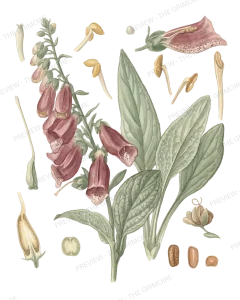
Tall spires of pink-purple, speckled bells that bees climb right into. In its first year it’s just a rosette of soft, hairy leaves, and that’s the tricky part: their young leaves can look a lot like comfrey. Foxglove is a heart poison, every part of it. Funny thing is, it’s also the plant behind one of medicine’s oldest heart drugs. In the 1700s, a folk remedy for swelling from Shropshire, England, led doctors to digitalis. Home remedies made people very ill along the way, so the medicine stays with the pharmacist.
Lookalikes: Comfrey (Nº 22). In its first year, foxglove is just a low rosette of soft, hairy, oval leaves, very like young comfrey before either of them flowers.
Admire its flowers, don’t use!
Monkshood (Aconitum napellus)
Deep-blue flowers shaped exactly like a monk’s hood, on tall spikes. It’s gorgeous at the back of a border. It’s also called wolfsbane, because it was once used to poison wolves, and it was known as the queen of poisons. Its toxin can get in through your skin, which is why the RHS says to avoid touching it. Gloves, every single time. Never grow it near vegetables, and never mistake its root for horseradish.
Lookalikes: Horseradish (Nº 47). Dug up, monkshood’s root can be mistaken for horseradish root, and people have been poisoned that way.
Admire its blue hoods, don’t use!
Autumn crocus (Colchicum autumnale)
In autumn, pink-lilac flowers pop straight out of bare ground, with no leaves at all (hence its old name, naked ladies). The leaves only come in spring. And that’s when it gets dangerous, because the leaves look like wild garlic. French poison centres recorded 28 mix-ups between autumn crocus and wild garlic in two years, and two people died. Wild garlic smells of garlic when you rub a leaf. Autumn crocus doesn’t. No smell, no pick.
Lookalikes: Wild garlic (Nº 148), Saffron (Nº 71). In spring its broad, glossy leaves come up in the same damp woods and meadows as wild garlic. In autumn its lilac, cup-shaped flowers look like saffron crocus, but saffron has three long red threads inside and autumn crocus doesn’t.
Admire its autumn flowers, don’t use!
February daphne (Daphne mezereum)
This is the perfume one. In late winter/early spring, bare stems get covered in pink-purple flowers that smell incredible, when the rest of the garden is still asleep. In summer come bright red berries, and those are the problem. Every part is poisonous, the berries especially, and the sap irritates skin. Old medicine had a strange belief: that a blister on the skin could pull illness out of the body. People once used its bark to raise blisters on purpose (please god, no), hoping it would cure rheumatism and toothache. If it can do that to skin, you really don’t want it anywhere near your mouth. Plant it away from paths and wear gloves when you prune.
Admire its scent, don’t use!
Tobacco (Nicotiana tabacum)
Tall, with huge sticky leaves and clusters of pink, tubular flowers. Ornamental tobacco plants are lovely in summer borders. But nicotine is a serious poison, and it can pass through your skin from wet leaves. Tobacco harvesters get a condition called green tobacco sickness just from working among dewy leaves. Old remedies laid wet leaves on bee stings, and gardeners once made nicotine bug sprays. Both are a VERY firm no. Nah-ah.
Admire its flowers, don’t use!
Aztec tobacco (Nicotiana rustica)
Shorter and stockier than ordinary tobacco, with broad leaves and small yellow-green flowers. It holds far more nicotine, and it’s the ceremonial tobacco of many Native American peoples. Respect that history, wear gloves if you grow it, and keep it away from children and pets.
Admire its history, don’t use!
Male fern (Dryopteris filix-mas)
A big, handsome fern whose fronds rise in a ring, like a shuttlecock. It’s tough and easy, great for that shady corner where nothing else grows. Its root was once a medicine for tapeworms, until people noticed the side effects: Health Canada lists liver damage, blindness and death. Enjoy it as a fern. That’s all it needs to be.
Admire its fronds, don’t use!
Poisonous wild plants in woods, hedgerows and waste ground
These ones turn up on their own: on walks, at the edge of fields, in hedges, and sometimes in your own garden without an invitation.
Jimsonweed, or thorn apple (Datura stramonium)
This is the one I actually know best, and not by choice. We have it in a few parts of our garden, and I cannot get rid of it for nothing. It’s honestly intriguing to look at: big, toothed leaves, huge white or lilac trumpet flowers that open in the evening and smell lovely at night, then seed pods covered in spikes like a tiny medieval weapon. Crush a leaf, though, and it stinks.
Every part of it is poisonous, and the sap can irritate skin. Its name comes from Jamestown, Virginia, where English soldiers ate the leaves in the 1600s and became delirious. If it’s in your garden too, the RHS says: pull it out wearing gloves before the spiky pods form, because each pod holds loads of seeds that stay alive in the soil for years. Don’t put seedy plants on your home compost; it won’t get hot enough to kill them. Fun fact: it often sneaks into gardens in birdseed mixes, so check under your bird feeder. (Maybe that’s how ours arrived. Dunno. It’s not telling.)
Admire its trumpets, don’t use!
Belladonna, or deadly nightshade (Atropa belladonna)
Soft oval leaves, purple-brown bell flowers, and shiny black berries sitting on a green star-shaped collar. Those berries look a lot like cherries, which is what makes it so dangerous for children. “Bella donna” means “beautiful lady” in Italian: women once dropped its juice in their eyes to make their pupils big. It blurred their vision. Beauty has always had a price, but that one was way too high. It’s still the source of atropine, a hospital medicine, made properly in a lab.
Lookalikes: Sour cherry (Nº 144), Bilberry (Nº 111). Its berries are shiny, round and dark, like small cherries or big bilberries. But belladonna berries sit singly on a green star-shaped collar, not in bunches on a cherry stalk or on a low bilberry bush.
Admire its bells, don’t use!
Henbane (Hyoscyamus niger)
Sticky, hairy and smelly, with pale yellow flowers laced with purple veins, like someone drew on them with a fine pen. It’s the old “witches’ herb” of European folk tales. Every part is poisonous and can cause confusion, hallucinations and a racing heart. Its roots have been mistaken for parsnip or chicory, so never dig up a mystery root.
Admire its veined flowers, don’t use!
American mayapple (Podophyllum peltatum)
A North American woodland plant that looks like a little colony of green umbrellas. Lift a pair of leaves and there’s a single white flower hiding underneath. Every part except the fully ripe fruit is poisonous, and the resin can burn skin. It’s the starting point for some prescription wart treatments and cancer medicines, which is exactly why it belongs with doctors and not in a home remedy.
Admire its umbrellas, don’t use!
Alder buckthorn (Frangula alnus)
You’ll find this slender shrub in damp woods and on heaths. It has glossy oval leaves and berries that change from green to red to black, and you’ll often see all three colours on the same branch, which looks lovely. But fresh bark and berries cause severe vomiting and cramps. Its aged bark is used in a licensed pharmacy laxative, and that’s a tested product, not something you strip off a tree.
Admire its rainbow berries, don’t use!
Common buckthorn (Rhamnus cathartica)
A thorny hedgerow shrub with clusters of small black berries in autumn, which children can easily mistake for something edible. The berries cause violent vomiting and diarrhoea. A nicer bit of history: artists once used the berries to make a green paint, so admire it in a painting instead.
Admire it in a painting, don’t use!
Wild lettuce (Lactuca virosa)
A tall plant with blue-green leaves, prickles along the veins and milky sap. That sap was once sold as “lettuce opium”. Today dried wild lettuce is sold online as a sleep aid, unregulated. The sap can cause dizziness, dilated pupils, anxiety and confusion, and it should never be mixed with sleeping pills or alcohol. Please skip it.
Lookalikes: Dandelion (Nº 118). Both have toothed leaves, small yellow flowers and white milky sap when you snap a stem. Wild lettuce grows tall and leafy, with prickles along the underside of the leaf’s middle vein; dandelion stays low, with one flower per hollow stalk.
Admire its blue-green leaves, don’t use!
Protected wild flowers you should never pick
These aren’t dangerous to you. You’re dangerous to them. They’re rare, slow to grow and easy to wipe out, so the rule is simple: look, take a photo, leave them exactly where they are.
Is it illegal to pick wild orchids?
Often, yes. Under the Wildlife and Countryside Act 1981, it’s illegal in Britain to pick, uproot or destroy any plant on its Schedule 8 list of protected plants, and it’s illegal to dig up any wild plant without the landowner’s permission. Several orchids are on that list. The BSBI also points out that every wild orchid falls under CITES, the international agreement on trade in endangered species. American national parks don’t allow picking wild plants either, apart from a few designated berries and nuts in some parks. Even where it’s technically allowed, an orchid dug up from the wild almost never survives in a garden. It needs the fungi in its own soil.
Lesser butterfly orchid (Platanthera bifolia)
Two broad, shiny leaves at the bottom and a spike of creamy-white flowers with long spurs, sweetly scented at night to call in the moths. I spotted my first one at the edge of a meadow by the woods, on an early-summer walk with my dog. I honestly didn’t believe it was a wild orchid until I got home and checked. In the 1700s and 1800s, ground orchid tubers made a hot drink sold on the streets of London. Please let that stay in the history books.
Admire its night scent, don’t pick!
Military orchid (Orchis militaris)
Look closely and every pink-grey flower is a tiny soldier: a helmet on top, arms and legs below. It’s one of the most charming flowers in Europe. In England, collectors and lost grassland pushed it so far that it was thought extinct in the 1920s. It was rediscovered in 1947, and its few British sites are now closely watched, some open only on special days. It’s on Schedule 8, so picking it is a crime.
Salute its little soldiers, don’t pick!
Club moss (Lycopodium clavatum)
Long, creeping stems covered in tiny scale-like leaves, with little yellow spore cones on forked stalks. Its family is older than the dinosaurs, which is a pretty good reason to leave it alone. The plant contains toxic alkaloids, so there’s no home use. Its spore dust once made the flash in early photography and stage effects, because it flares up when lit. Picking it is restricted or banned in some places, so leave it be.
Admire its ancient stems, don’t pick!
Plants that are illegal to grow or own
Two plants with a long, complicated history, where the law matters as much as the poison.
Opium poppy (Papaver somniferum)
Grey-green leaves that clasp the stem, huge papery flowers in lilac, white or red, then round seed heads that look great in a vase. I live in a small village, and a few years back a poppy simply appeared in our garden. Mostly, though, I see poppies on walks with my dog along the fields nearby. Most bright red field poppies are corn poppies, a different plant from the opium poppy.
The opium poppy is the source of morphine and codeine, and the RHS lists it as harmful if eaten. Food-grade poppy seeds in bread and cake are fine. Anything made from the seed heads is not, ever, and especially never for children.
Lookalikes: Red poppy (Nº 69). Both have big, papery, crumpled-looking petals and round seed heads. The opium poppy has grey-green leaves that wrap around the stem and bigger flowers in lilac, white or red; the red poppy has hairy, green, finely cut leaves and smaller scarlet flowers.
Is it illegal to grow opium poppies?
This one genuinely depends on where you live. In the UK, it’s a common cottage-garden flower, and growing it for its looks isn’t against the law; taking anything from it for drugs is. In the US, federal law lists the opium poppy itself as a Schedule II controlled substance, even though the seeds are sold for baking. Laws change, so check yours.
Admire its petals, don’t use!
Coca (Erythroxylum coca)
A modest shrub with small oval leaves, each marked by two curved lines beside the middle vein, plus little yellow-white flowers and red berries. In the Andes of Peru and Bolivia, coca leaf has been part of daily life and culture for thousands of years. It’s also the source of cocaine, which is why it’s illegal to grow (obviously), buy or own in most countries, coca tea included. US federal law lists coca leaves under the same Schedule II. Here, it’s botany and history only, and please don’t bring leaves or tea home from your travels.
Admire its story, don’t use!
Poisonous medicinal plants from history
You’re unlikely to meet these on a walk unless you travel far. I included them because their stories are too good to skip, and because each one shows why “natural” and “safe” are two very different words.
Yellow cinchona (Cinchona calisaya) and red cinchona (Cinchona pubescens)
Evergreen trees of the Andes with fragrant pink flowers and bitter bark that changed world history. Don’t let the names confuse you: “yellow” and “red” describe the colour of the bark, not the flowers. Honestly, it messed me up at first too. The Quechua, Cañari and Chimú peoples knew the bark’s power first, and from the 1600s it was shipped to Europe as the source of quinine, the old treatment for malaria. According to Kew, it’s the national tree of Ecuador and Peru, and wild trees have suffered badly from over-harvesting. Quinine itself is poisonous and stays a prescription medicine. The bit of it in your tonic water is the only meeting you need.
A little note from me: I’m learning this from books and websites, not from the people whose history it actually is. So if you’re from Ecuador or Peru and I got something wrong, please hit me up and correct me. And tell me what cinchona means in your culture, too. I’m honestly craving to know more.
Admire their pink flowers, don’t use!
Jaborandi (Pilocarpus pennatifolius)
A South American shrub with leathery leaves and small reddish flowers. Jaborandi plants are the source of pilocarpine, which is used in glaucoma eye drops. The plant itself causes heavy sweating, drooling and a slowed heart, so it belongs in the pharmacy, not the teapot!
Admire its glossy leaves, don’t use!
Kamala (Mallotus philippensis)
A tropical tree from South Asia and Australia whose small fruit are dusted in fine, brick-red powder. That powder dyed silk and was once a harsh worm remedy and purgative. Silk, yes. Swallowing, no.
Admire its red dust from afar, don’t use!
Kousso (Hagenia abyssinica)
A mountain tree from the Ethiopian highlands, part of the rose family, with big drooping clusters of reddish flowers. Those flowers were a traditional tapeworm remedy in highland Ethiopia. Too much causes vomiting and problems with eyesight. Beautiful tree… very bad tea. (Yeah, it rhymes. You’re welcome.)
Admire its drooping flowers, don’t use!
Wormseed (Artemisia cina)
A grey, aromatic shrub from the steppe of Kazakhstan, with feathery leaves and tiny yellowish buds. The buds gave santonin, an old cure for roundworm that was hidden in sweets and lozenges for children. It caused yellow vision and seizures, and children died. Hidden in sweets. Let that sink in.
Admire its grey leaves, don’t use!
Poisonous plants: what to do if someone swallows one
Don’t panic, and don’t try to make them sick. The RHS is very clear on that one.
- Take out anything left in their mouth.
- Call for help straight away, even if they seem fine. NHS advice is that symptoms can take hours or even days to start. Find out your country’s emergency number, and whether there’s a poison centre or poisons helpline where you live. For example:
• In the UK: call 999 or go to A&E if you think they’ve swallowed something poisonous, or if they’re unconscious, struggling to breathe or having a fit. If you’re not sure the plant is harmful, call NHS 111. Don’t give them anything to eat or drink.
• In the US: call Poison Control on 1-800-222-1222, or 911 in an emergency. - Take a piece of the plant with you, or a clear photo. Doctors need to know exactly what it was.
- For skin contact, wash the area with soap and water and take off any clothing the sap touched.
Save the numbers in your phone now. Seriously, right now. Future you will be grateful.
Can you grow poisonous plants safely?
Yes. Most gardens already have a few, and the RHS says they’re safe to grow if you treat them with respect. Here’s what that looks like in real life:
- Gloves on for pruning, weeding and pulling anything on this list. Wash your hands after, even with gloves.
- Keep them apart from food. Don’t grow ornamental and edible plants in the same bed or pot, so nothing poisonous ends up in the salad bowl by accident.
- Think about who visits. Small children and pets explore with their mouths. If they’re around a lot, skip the worst ones (belladonna, monkshood, daphne) or plant them well out of reach.
- Clear up prunings and pulled plants straight away, so no one nibbles them later.
- Label what you plant, especially anything that looks like a herb.
- Pets react differently from people. The HTA guide lists plants that are harmful to dogs, cats and other animals, and if your pet eats something suspicious, call your vet.
FAQ
Is foxglove poisonous to touch?
The real danger is eating it: every part is a heart poison if swallowed. Touching it is much lower risk, but wear gloves when you handle it and wash your hands after, especially before eating or touching your face.
Which plants look like wild garlic but are poisonous?
Mainly autumn crocus and lily of the valley, according to Germany’s Federal Institute for Risk Assessment. Rub a leaf: wild garlic smells strongly of garlic. No smell, no pick, and wash your hands.
Is it illegal to pick wild flowers in the UK?
Picking a few common wild flowers is usually fine. Digging any wild plant up without the landowner’s permission is illegal, and picking anything on Schedule 8 of the Wildlife and Countryside Act, like the military orchid, is illegal anywhere in Britain. In the US, national parks don’t allow picking wild plants, apart from a few designated berries and nuts in some parks.
What should I do if my toddler eats a berry?
Take anything left out of their mouth, don’t make them sick, and get advice straight away: in the UK, 999 or A&E if you think the berry is poisonous, or NHS 111 if you’re not sure; in the US, Poison Control on 1-800-222-1222, or 911 in an emergency. Bring the berry or a photo of the plant.
Are these plants poisonous to dogs and cats?
Many of them, yes, and some plants affect pets differently from people. Check the HTA guide and call your vet if your pet eats something you’re not sure about.
What is the most poisonous plant in the UK?
There’s no single official answer. The RHS puts monkshood and deadly nightshade among the small group of more toxic garden plants, and both can be deadly. The good news: serious poisoning is still very uncommon.
Admire them, then leave them be
So that’s the list. Beautiful, strange, sometimes amazing-smelling plants that are much better looked at than touched. Knowing them doesn’t make a garden or a walk scarier. It makes it more interesting, because now you know what you’re looking at.
Which of these have you spotted? And does anyone else have a thorn apple they can’t get rid of, or is it just me? Tell me in the comments.
If you’d like to meet these plants properly, each one has its own illustrated page in the Atlas section of the Grimoire, with its story, its look and why it’s one to admire only. And if you love how they look, foxglove, belladonna, monkshood and their dangerous cousins are also in The Shadow Garden image pack: moody plates for prints, autumn cards and journals. The safest way to keep them close is on your wall.
miru
miru is not a herbalist or a botanist, just a curious person who loves plants, old books and research. She checks everything twice and cross-references it. Nothing here is medical advice: if in doubt, ask a doctor or pharmacist.
Sources
- RHS: Potentially harmful garden plants
- RHS: Thorn apple
- NC State Extension Plant Toolbox: Datura stramonium
- ANSES: Confusion between autumn crocus and wild garlic
- BfR: Wild garlic confusion often leads to poisoning
- CDC MMWR: Green tobacco sickness in tobacco harvesters
- Health Canada: Advisory on male fern
- Wildlife and Countryside Act 1981, section 13
- BSBI: Code of Conduct for picking wild plants
- BSBI: Orchis militaris species account
- eCFR: 21 CFR 1308.12, Schedule II
- Royal Botanic Gardens, Kew: Cinchona tree
- NHS: Poisoning
- Poison Control: Poisonous and non-poisonous plants
- HTA: Potentially harmful plants