You’ve seen the pictures. Shelves of amber bottles, tiny handwritten labels, bundles of something drying in a window with perfect light. Searches for “herbal apothecary” on Pinterest went up almost 600% this year, so you’re definitely not the only one saving them.
What the pictures don’t show is that you don’t need any of it to start. A home herbal apothecary can be one shelf in a dark cupboard, a few jars and a pen. I keep a pot of mint by the kettle and smell it every morning while the water boils for coffee. That’s about as aesthetic as my mornings get.
This guide covers which herbs to start with, what you actually need, how to store everything so it doesn’t turn into flavourless green dust, and three simple things to make. I’m not a herbalist, so I checked all of this against the NHS, the NIH and a few universities. The links are at the end, if you’re a research nerd like me.
What is a home apothecary?
A home apothecary is a small, labelled collection of dried herbs and simple preparations, like teas and infused oils, that you keep for everyday things: a tickly cough, a bloated tummy, a bad night, a graze.
It isn’t a pharmacy, and it doesn’t replace a doctor. The NHS describes herbal self-care as being for things like coughs, colds and general aches and pains, and that’s a good line to hold. Anything serious goes to a doctor.
How to start a home apothecary in 5 steps
- Choose three to five herbs you’ll actually use. Six good beginner herbs are below.
- Get the supplies. Jars with lids, labels, a pen and a dark cupboard. That’s the core of it.
- Get the herbs. Grow them, buy them or forage them, each with its own rules.
- Store them properly. Airtight, cool, dark and dry, with a name and date on every jar.
- Make your first preparation and write it down. A cup of tea counts. Note what you made, when, and how you felt.
Each step has its own section below, so jump to whichever one you need.
Best herbs for a beginner home apothecary
These six turn up on nearly every beginner list, and for good reasons: they’re easy to grow or buy, they’re used for everyday complaints, and they’re gentle when used sensibly. You don’t need all six. Pick the three you’d actually reach for.
Chamomile (Matricaria chamomilla)
The one for a bloated or crampy tummy, and for calming down before bed. It’s also used as a rinse for mouth ulcers.
Sow the tiny seeds on top of the soil in spring or autumn and don’t cover them, because they need light to sprout. Pick the flowers when they’re fully open, on a dry, sunny day. Dried, they keep about a year.
Skip it if you’re allergic to ragweed or the daisy family, and check with a doctor if you take blood thinners. Chamomile medicines are usually meant for adults and over-12s, according to the EMA.
Peppermint (Mentha × piperita)
A cup after a heavy meal, for indigestion, bloating and wind.
Grow it in a big pot. Always. It spreads by runners, and in the ground it takes over the whole bed, then the neighbour’s. Cut the stems just before it flowers, on a dry morning. Dried, it keeps about a year.
It can make heartburn and reflux worse, and it isn’t recommended for children under four, because there isn’t enough safety data (EMA). Peppermint oil is stronger stuff: never put it on a baby’s or young child’s face, because menthol can affect their breathing (NIH).
Thyme (Thymus vulgaris)
There’s a good chance it’s already in your spice rack. People have made thyme tea or a thyme steam for a chesty cough with a cold for centuries, and it’s traditionally used for a sore throat and for bloating too.
It wants a sunny, dry, gritty spot or a pot, and it hates damp. Cut sprigs just before and during flowering. Dried, it keeps about a year.
Thyme tea isn’t recommended for children under four, and most thyme products are only for over-12s, so check the label (EMA). Medicinal amounts aren’t recommended in pregnancy or breastfeeding. Thyme essential oil is a different thing altogether: very strong, always diluted, never taken by mouth at home, and never used on babies under two.
Ginger (Zingiber officinale)
For motion sickness and nausea, and traditionally for digestion and colds.
The supermarket is fine here. Fresh ginger freezes well, and dried slices keep about a year. (You can even plant a plump piece with visible buds in a wide pot in spring. It takes eight to ten months, so this one’s a patience project.)
It can cause heartburn. Avoid it with gallstones, ask your doctor if you take blood thinners, and don’t give ginger remedies to children under six. For tummy troubles, ginger remedies are only recommended for over-18s (EMA). Ginger in your cooking is a different matter. For morning sickness, only on your midwife’s or doctor’s advice.
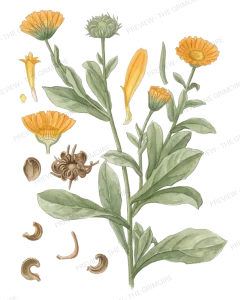
Calendula (Calendula officinalis)
The skin one: grazes, small cuts, chapped hands and sore, irritated skin. It’s also used as a rinse for a sore mouth or throat.
Sow it straight into the ground from March to May. It likes dry better than wet, and it self-seeds, so expect it to pop up next year somewhere you didn’t plan. Pick whole flower heads around midday on a dry day. Dried, they keep about a year, and faded petals mean they’re past it.
Leave it alone if you’re allergic to the daisy family, and patch-test before using it on skin. It isn’t recommended for children under six, and most calendula creams and ointments are only for over-12s (EMA). In pregnancy and breastfeeding, only on a doctor’s advice.
Lemon balm (Melissa officinalis)
For mild stress, a nervous tummy and a slightly better night’s sleep.
It grows in sun or part shade in any reasonable soil. Cut the flowers off unless you want lemon balm everywhere. It loses its lemony smell fast, so dried leaves only keep about six months.
Large amounts can make you drowsy, so don’t combine it with sedative medicines. Take care with thyroid conditions. It isn’t recommended for children under twelve (EMA), and there’s no safety data for pregnancy.
Where to get your herbs: grow, buy or forage
Grow them
The cheapest herbs are the ones on your windowsill or in your garden. Pick them just before the flowers open, then dry them indoors, somewhere airy and out of direct sunlight. Sun fades their colour and flavour (Oregon State University Extension). I’ve written a whole guide on how to dry herbs at home, and all you really need is a rubber band and a shady corner of the kitchen.
Buy them in the UK
Loose dried herbs from a trusted shop are perfect for teas. For ready-made herbal remedies, the NHS suggests looking for a THR (traditional herbal registration) mark on the packaging. Two things to know about it: the claims are based on traditional use, not evidence that it works, and the mark doesn’t mean a product is safe for everyone. The NHS also warns that herbal products bought online can contain banned ingredients and toxic substances.
Buy them in the US
In the US, herbal supplements don’t have to meet the safety and effectiveness standards that medicines do before they’re sold, and some have been found contaminated with metals or unlabelled drugs (NIH, Herbs at a Glance). So buy from sellers who tell you exactly what’s in the bag and where it came from.
Buy them sustainably
This is the part almost nobody mentions. According to the American Botanical Council, about two-thirds of herbs in commerce are collected from the wild (New Hope). The FairWild label means the plants were harvested sustainably and the people picking them got a fair price. Some herbal tea brands carry it. If you can grow it yourself, even better.
Forage them in the UK
Never eat a wild plant unless you’re absolutely certain what it is (Woodland Trust). The BSBI Code of Conduct says to take only 1 in 20 of what you find, and uprooting any plant is illegal without the landowner’s permission. Some places ban foraging completely, including the Royal Parks in London (Country & Town House), so check before you pick.
Forage them in the US
Gathering plants in National Park System areas is prohibited unless it’s specifically authorised (Federal Register, National Park Service). Before you pick anything wild, check the United Plant Savers at-risk list. Black cohosh, American ginseng and echinacea are all on it, so buy those cultivated.
Watch out for lookalikes
Some herbs have dangerous twins: wild garlic and lily of the valley, wild carrot and hemlock. 100% sure, or don’t pick it.
Home apothecary supplies: what you actually need
- Glass jars with tight lids. Reused jam and pickle jars are perfect. Run them through the dishwasher and make sure they’re completely dry.
- Labels and a pen. Masking tape works fine.
- A dark cupboard or shelf. If your jars live in the dark, the colour of the glass stops mattering. Amber glass is lovely, but a cupboard door does the same job for free.
- A tea strainer and a small pan. For teas and decoctions.
- A notebook. For what you made, when, and how it went.
That’s the list. Mortar and pestle, dropper bottles and a scale can come later, if you find you actually need them.
Do you need an apothecary starter kit?
No, not to start. You need a few jars and three herbs you’ll actually use. Everything else is someone selling you a full-time hobby you can’t manage with a full-time job, or kids, or kids AND a job.
Don’t get me wrong, a kit can make a lovely gift. Just check a few things before you buy one:
- How many herbs? Some kits on Etsy come with 42 jars. That’s 42 herbs going stale at the same time, most of which you’ll never open.
- Is each herb labelled with its Latin name? “Sage” can mean several different plants. The Latin name tells you exactly which one you’ve got. And well, you also get that witchy, whimsical mood you’re going for. Latin names on jars and containers look fiiiiine.
- Does it say where the herbs come from? Growers, country, organic or FairWild. If it doesn’t say, ask.
- Is it sold for spells or for tea? Herbs packed for altars or spell jars aren’t necessarily food grade, so don’t brew them unless the seller says they are.
A kit can’t tell you which herbs suit you. A cup of tea and a notebook can.
How to store dried herbs
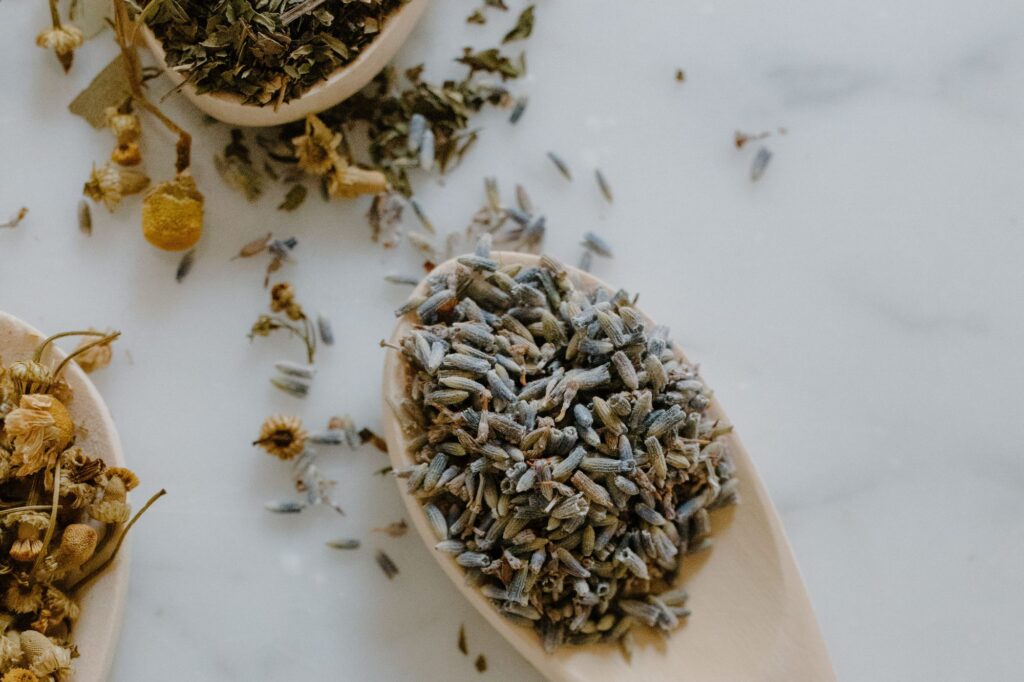
Dried herbs have four enemies: light, heat, air and moisture. Keep them in airtight containers somewhere cool, dark and dry. The freezer works too, as long as the container is airtight (Oregon State University Extension).
The best tip I’ve found: keep leaves and seeds whole, and crumble them only when you use them. Whole leaves and seeds keep their flavour longest, and ground herbs the shortest.
And label every jar with the name and the date. Please actually do this. In three months every jar of green crumbs looks exactly the same, and you’ll be standing there sniffing jars like a detective.
How long do dried herbs last?
| Herb | Part you keep | Keeps for |
|---|---|---|
| Chamomile | Flower heads | About 1 year |
| Peppermint | Leaves | About 1 year |
| Thyme | Leaves and flowering tops | About 1 year |
| Ginger | Dried slices | About 1 year |
| Calendula | Flower heads | About 1 year |
| Lemon balm | Leaves | About 6 months |
These are for quality, not a hard expiry date. A herb that’s past it looks faded and smells of very little. If you rub a pinch between your fingers and get nothing, it’s compost.
How to make a herbal infusion, decoction and infused oil
Three preparations cover most of what a beginner needs. Use kitchen amounts: a teaspoon or two of dried leaves or flowers to a cup.
Herbal infusion (tea)
This is for leaves and flowers, like chamomile, peppermint, thyme and lemon balm.
- Put 1 to 2 teaspoons of dried herb in a cup or teapot.
- Pour over hot water.
- Cover the cup with a saucer.
- Leave it for 5 to 10 minutes, then strain.
The saucer is the most important part. Aromatic herbs lose their oils with the steam, and the more fragrant the herb, the more you lose if you leave the cup open. A saucer. Revolutionary, I know.
Decoction
This is for the tough parts: roots, bark and seeds. Instead of steeping, you simmer them, and hard roots and bark need 20 to 45 minutes. Fresh ginger is easier: slice 2 to 3 cm, simmer it in a cup of water for 10 minutes, strain and sip.
If you’re using seeds like fennel, bash them lightly first to release their oils.
Calendula infused oil
This one is for skin, not for cooking.
- Fill a clean, dry jar with dried calendula flower heads.
- Cover them completely with olive oil.
- Leave it somewhere warm for 3 to 4 weeks.
- Strain, bottle and label it.
Use dried flowers only. Fresh plants bring water into the oil, and the bacteria behind botulism need water to grow. Dried herbs add no water, which is why they’re the safer choice (University of Maine Extension). Keep the finished oil somewhere cool and dark, and if it ever turns cloudy or smells off, throw it away.
Two things I’ve deliberately left off a beginner’s shelf: tinctures, and anything with fresh garlic in oil. Garlic in oil can grow botulism if it isn’t handled exactly right, and that’s not a mistake you want to learn from.
Is a home apothecary safe?
Yes, if you keep it for everyday things and stay honest about its limits. My grandma was a hospital nurse for 40 years and still reached for herbs and tinctures.
A few rules I keep:
- Herbs are for everyday stuff: a tickly cough, a bloated tummy, a bad night. Anything serious goes to a doctor.
- Please don’t stop your medication. Herbs go alongside your treatment, not instead of it.
- On medication, pregnant, or making it for a child? DEFINITELY check with a doctor or pharmacist first, especially if you’re no expert. Neither am I.
- “Traditionally used” means people have used it for a long time. It doesn’t mean it’s proven.
- If it gets worse, or isn’t better in a few days, see a doctor.
A THR mark on a product means traditional use, not proof, and it doesn’t make a product safe for everyone (NHS). In the US, tell all your healthcare providers about any herbs you use, and take extra care in pregnancy, when breastfeeding and with children (NIH).
FAQ
How much does it cost to start a home apothecary?
If you already have a few jars, almost nothing. Your main cost is the herbs, and you might already own some. Start with three and add more only when you’ve used them.
What herbs should a beginner start with?
Chamomile, peppermint, thyme, ginger, calendula and lemon balm are all easy to find and gentle when used sensibly. Pick the three you’d actually use.
Are supermarket dried herbs good enough?
For teas, yes, as long as they’re fresh. Check the date, then rub a pinch between your fingers. Good colour and a strong smell mean they’re still worth using.
How long do dried herbs last?
Most leaves and flowers keep their quality for about a year, stored airtight somewhere cool and dark. Lemon balm fades faster, in about six months. Whole leaves last longer than crumbled ones.
Can I make a home apothecary in a small flat or apartment?
Yes. One shelf in a cupboard is enough. Peppermint and thyme grow happily in pots on a sunny windowsill.
Is it legal to forage herbs?
Usually, for small amounts for yourself, but it depends on where you’re standing. Pulling up a whole plant without the landowner’s permission is illegal in Britain (BSBI), American national parks don’t allow picking without permission (National Park Service), and plenty of parks ban it completely. So check the rules for that spot before you pick.
What’s the difference between an infusion and a decoction?
An infusion is steeped, like tea, and suits leaves and flowers. A decoction is simmered, and suits roots, bark and seeds.
Start small
One shelf, three herbs, a few jars with dates on them. Use them, notice what works for you, and add the next herb when you actually miss it.
If you’d like a reference book for that shelf, the Grimoire has 211 herbs, one illustrated page each, with how to grow them, harvest them, keep them and use them, plus cautions where they matter.
So, which herb is going on your shelf first?
miru
I’m not a herbalist or a botanist. I’m a curious person learning in public, and I check everything twice, make tweaks and cross-reference. If you spot something wrong, tell me at hello@miruherbs.com and I’ll fix it.
Sources
- Herb facts: the miru herbs Grimoire, cross-checked against the European Medicines Agency herbal monographs, including Matricariae flos (chamomile)
- NHS: Herbal medicines
- NIH NCCIH: Dietary and herbal supplements
- Oregon State University Extension: Drying herbs
- University of Maine Extension: Safe homemade flavored and infused oils
- BSBI Code of Conduct
- Woodland Trust: Responsible foraging guidelines
- United Plant Savers: Species at-risk list
- Federal Register: National Park Service plant gathering rule (2016)
- American Botanical Council figure on wild-collected herbs, reported by New Hope
- Pinterest Hobbies Trend Report 2026